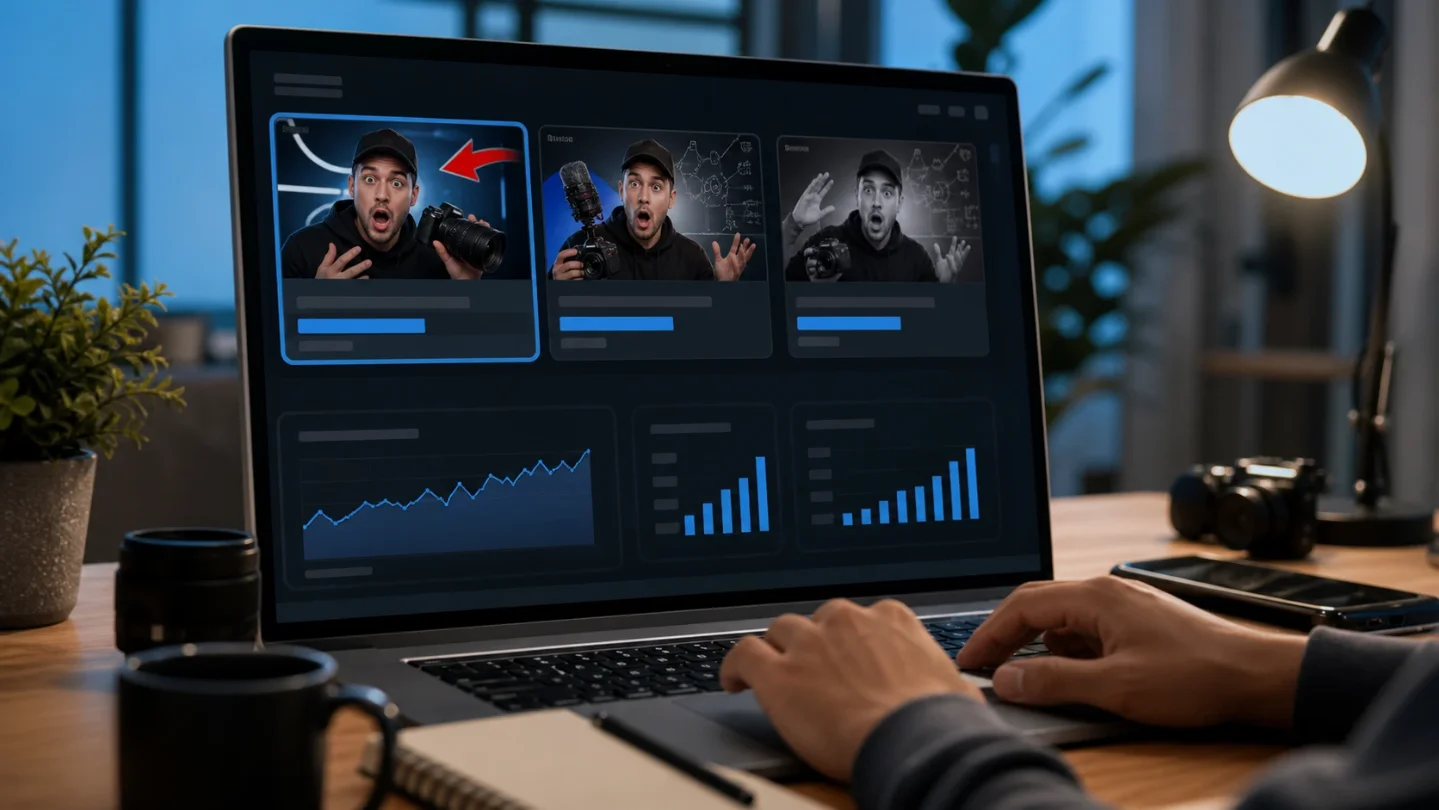
Three public thumbnail tests that say more than the winner label
Three public YouTube creator experiments on thumbnails and titles, including one clear hook win and two cases where the sample was too thin to trust the verdict. The takeaway is to test bigger concepts first and treat a winner label as directional until impressions are strong enough.

The cleanest public win in this batch is Brad Smith's three-thumbnail test: thumbnail 2 took 38% of the watch-time share, ahead of 31% and 30%. 1
What matters more than the winner label, though, is how much of the result came from the hook itself rather than from cosmetic polish. In the strongest cases below, the change that moved the needle was the promise in the thumbnail, not just the surface treatment.
Top 3 tests
1. Brad Smith: the hook beat the decoration
- Who ran it: Brad Smith, who publishes YouTube growth tutorials for AutomationLinks.
- What changed: three versions of the same basic thumbnail, with the hook text rewritten so each variation pushed a slightly different promise.
- Result: thumbnail 2 won with 38% of the watch-time share, ahead of thumbnail 1 at 31% and thumbnail 3 at 30%. 1
- Why it likely won: the image stayed familiar, so the text had to do the real work. A sharper hook lowers the amount of reading a viewer has to do in the feed.
- How to apply it: test the hook before you test color, borders, or tiny layout changes. If the promise is weak, prettier packaging usually just makes the weakness easier to see.
2. Jeven Dovey: small differences produced a preferred result, bigger gaps produced a clearer winner
- Who ran it: Jeven Dovey, on videos walking through YouTube's Test & Compare feature.
- What changed: one two-thumbnail test and one three-thumbnail test, each using separate thumbnail concepts rather than tiny edits.
- Result: one two-thumbnail test ended with a preferred result at 52.9% versus 47.1%, while a separate three-thumbnail test ran from April 2 to April 5 and picked thumbnail 2 at 36%, ahead of 32.1% and 31.9%. 2
- Why it likely won: the tighter result shows what happens when the variants are close; the three-way run shows that a bigger concept gap gives the tool a cleaner read.
- How to apply it: start with noticeably different thumbnail ideas, then refine the winner. If the spread stays narrow, treat the result as directional and run a second pass.
3. Jamar Diggs: small channels can get a label without getting a verdict
- Who ran it: Jamar Diggs, on a client channel and on his own channel.
- What changed: three thumbnail options were tested on a client video, with a second round of testing on his own channel.
- Result: on the client video, thumbnail 2 reached about 40% of watch-time share, but the test still was not conclusive when the video had only around 200 views. On his own channel, the report was also inconclusive. 3
- Why it likely won: the sample was thin, so the report could point toward a preferred option without being confident enough to call a winner.
- How to apply it: if a channel is still early, the tool is useful as a directional read, not as a final authority. Manual swaps and longer observation windows can be more honest than waiting for a label that never becomes certain.
The practical rule
YouTube's built-in tester is not trying to crown the clickiest thumbnail. It is trying to choose the version that earns the most watch time after the click. 4 That is why a thumbnail can look good on paper and still lose if it attracts the wrong viewers, and why a preferred result on a small channel should be read as a hint rather than a conclusion.
The safer workflow is simple: test the hook first, then widen the concept gap when the data is murky, and only trust the label when the impression volume is big enough to make the decision boring.
Related content
- Sign in to comment.